Tutorial: Snowboard Stance and Setup
Please feel free to ask questions and I will be more than happy to help you. 
STANCE AND SETUP
The important thing to understand is there is no ‘best’ stance. The best stance is what works and feels comfortable for your riding style. I highly recommend playing around with your stance so you can feel the subtle differences. Only then can you truly know what works best for you. This guide will help you understand how to choose your stance and how it all works.
REGULAR OR GOOFY:
The first thing you need to determine is whether you have a regular or goofy stance. Regular stance means your left foot is the leading foot. Goofy stance means your right foot is the leading foot. If you skate, surf, or ride any board, you should already know if you have a regular or goofy stance.
Try to imagine yourself turning on a snowboard. What side of your body would you prefer to lead with?
More often than not, your dominant foot (i.e. foot you kick a ball with) will be the back foot on your snowboard - however this doesn’t always happen to be true.
If you are still unsure, the best thing to do is go snowboarding and see what feels best. You will soon work out your preferred stance.
BINDING ANGLES:
Each binding needs to be attached to your snowboard at an angle. Any binding angled towards the nose (front) of the board is said to have a positive angle. Any binding angled towards the tail (back) of the board is said to have a negative angle. Any binding placed perpendicular to the length on the board is said to have an angle of zero degrees. The factors which determine a snowboarder’s binding angles are comfort, ability level, and riding style.
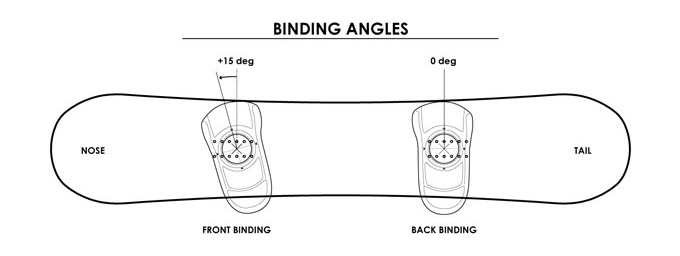
Beginners should use a directional stance; this means your snowboard will be set up to travel favourably in one direction. As a beginner snowboarder learns the basic skills of snowboarding, the ultimate goal is to start linking turns; this will be easier with a directional stance. I suggest you start with an angle of 15 to 18 degrees on the front binding, and 0 degrees on the back binding. This is a good stance to start with.
As your skill level progresses you might want to start learning freestyle tricks such as a 180. Learning to ride switch really opens the door to freestyle progression. To perform a 180 you need to be able to take off or land in switch stance (riding in the opposite direction to your preferred stance). By having the back binding at a negative angle (angled towards the tail of your board), you make riding switch significantly easier: this is called duck stance.
Duck stance is more versatile and opens your body to travel in both directions. For this reason duck stance is preferred by many snowboarders. If you are trying a duck stance for the first time, start small and see how it feels. Most binding angles increment by three degrees; try an angle of negative three or negative six degrees on the back foot. For a more dramatic effect, try an angle up to negative 15 degrees. A lot of snowboarders also find duck stance more comfortable on their knees.
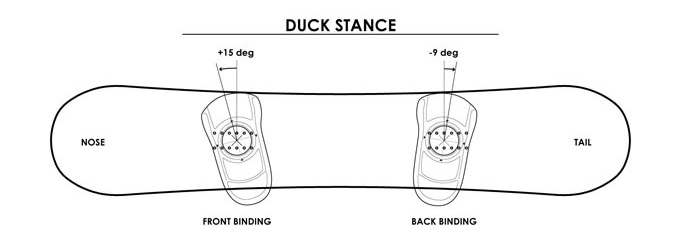
Always have at least 12 degrees on your front foot; any less will make turn initiation unnecessarily difficult. These days the majority of snowboarders will have between 15 and 24 degrees on their front binding and between 0 and negative 15 degrees on their back binding.
STANCE WIDTH:
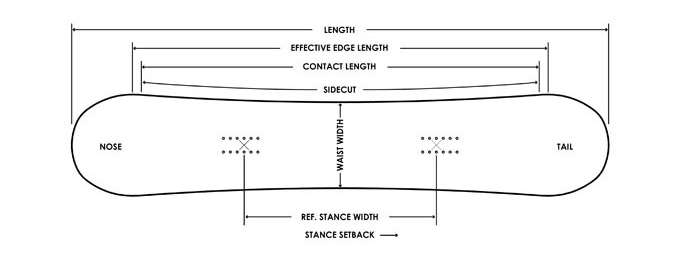
Stance width is the distance between the left and right bindings; it is measured from the centre of each baseplate (the round disc in the bottom of the binding). Ability level, riding style, and comfort all need to be considered when choosing your stance width. It is likely you will have to try a few different stance widths to see what works best for you.
Beginners should start with a narrower stance for two reasons. Firstly, you are new to snowboarding and therefore don’t have a preferred stance just yet; it is always better to start narrower, and then try wider. Secondly, the ultimate goal of a beginner is to start linking turns; a narrower stance makes it easier to pivot, and therefore turn.
Freeriding requires a narrower stance. Generally speaking, a narrower stance is better for turning with high performance; it enables the rider to exert more force through a more concentrated section of the edge, makes turning more responsive, and makes riding powder easier.
Freestyle requires a wider stance. Generally speaking, a wider stance provides more stability and versatility; it enables the rider to apply more pressure to the nose and tail of the snowboard (for presses and tricks), makes landings more stable (on rails or jumps), and tweaking body position (for added style) much easier.
Comfort is the most important consideration for stance width; your stance should always feel comfortable. Shoulder width is apart is a safe starting point; if you are new to snowboarding always start narrower, and then gradually try wider. As your riding progresses it is important to try different stance widths to see what feels most comfortable while giving maximum performance for your riding style.
Continued…
STANCE SETBACK:
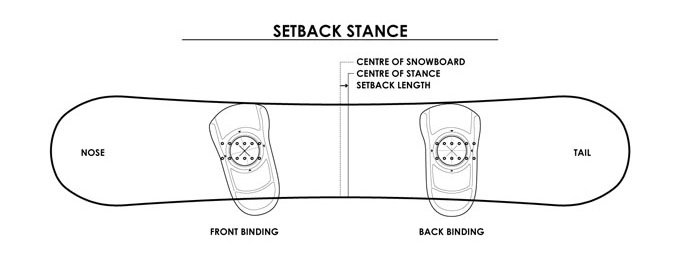
A setback stance means the centre of your stance is offset from the centre of the snowboard towards the tail; this stance is generally favourable for freeriding. The average setback for a freeride stance is approximately one inch. It enables you to apply more pressure to the back of their snowboard, generating more power in turns. A setback stance is particularly beneficial for riding powder. For deep powder, you can set your stance back even further; two inches or more. It applies more weight to the back of the board causing the tail to sink, the nose to rise, and the board to float on top of the snow - just like a surfboard.
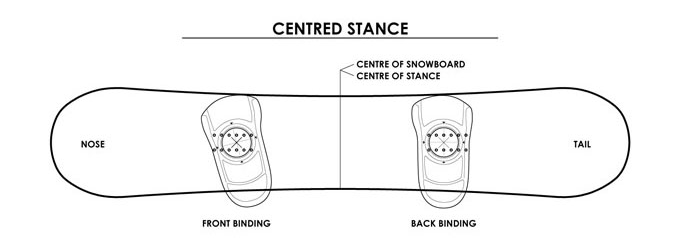
A centred stance means the centre of your stance is also the centre of the snowboard; this stance is generally favourable for freestyle. A centred stance is versatile, makes spinning easier, and enables you to ride with equal ease in both directions. Switch riding is a very important aspect of freestyle; a centred stance simply makes this easier.
BINDING POSITION:
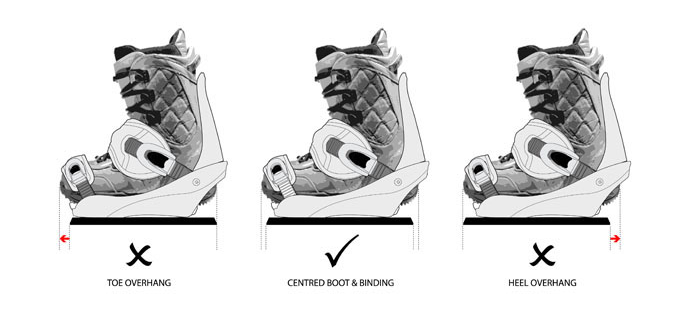
Each binding can be moved towards either the toe or heel edge of the snowboard. Your bindings need to be positioned in a way that your boot is centred between the toe and heel edges. If your boots hang over one edge more than the other, your entire body position will be out of alignment with the snowboard. You also increase the risk of your boots digging into the snow when making a turn.
To see if your boots are centred on the snowboard - strap your boots into the binding and flip the board upside down. You will be able to see if your boots hang over one edge more than the other. If your boots hang over the toe edge more than the heel edge, move the bindings down towards the heel edge. If your boots hang over the heel edge more than the toe edge, move your bindings up towards the toe edge.
HIGHBACK ROTATION:
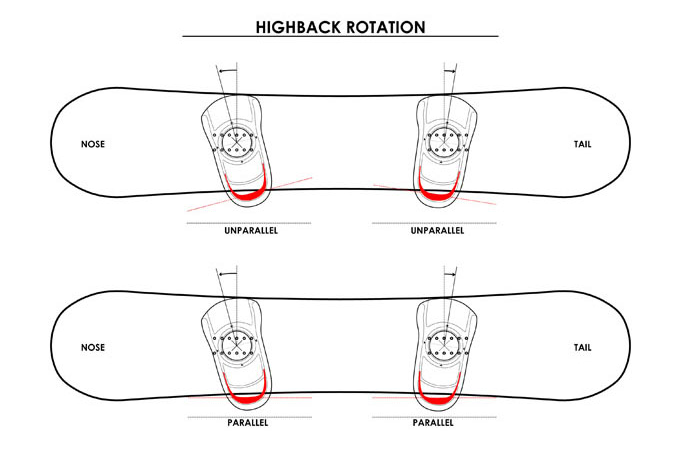
The highbacks on your binding should be rotated so they are parallel with the heel edge. The highbacks work as a lever; if they are parallel they work more effectively and enable you to transfer from edge to edge with less effort. If the highbacks are parallel it is also easier to flex your boots towards the nose or tail of the snowboard; this enables you to apply more pressure to the nose or tail for presses, or for tweaking your body position in the air when grabbing for better style.
* Not all bindings allow for highback rotation, which is perfectly fine; these bindings are generally designed to work effectively without the need for highback rotation (example: Now Bindings).

i only just recently learnt to rotate my high backs due to a post like this somewhere on the net. i had never even thought of it until it was pointed out and i went “ahhhhhhhhhhhhhhhhhhhhhh!” was a lightbulb moment thats for sure.

makes a hell of a difference huh

Nice post Rider :D
I have just been thinking about how I’m gonna setup my bindings. This is a big help !!
makes a hell of a difference huh
i havent ridden this year so will find out in 2 weeks( hopefully sooner)

very informative thank you so much
boardworld rocks!!!

very informative thank you so much
boardworld rocks!!!
agreed very good 
Whether you’ve been wandering the internet or got a recommendation from a friend – it doesn’t matter, we are glad you’re here! If you need qualified support in creating your research proposal literature review, there is no better place. Our service is famous for its reliability, premium quality, affordable price, and expeditious work. As you can see there are a lot of advantages, so let’s look closer at how we can assist you so you can obtain the best results.